
What causes Carpal Tunnel Syndrome (CTS) and who gets it?
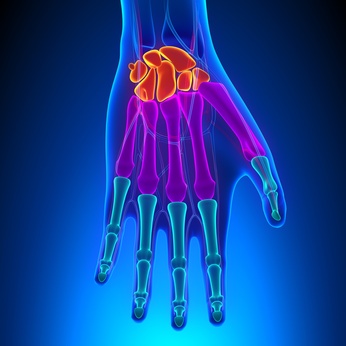 Carpal Tunnel Syndrome (CTS), the most common repetitive-stress injury affects millions of people a year. It is a manifestation of nerve and tissue damage caused by fast, forceful and seemingly harmless repetitive wrist and hand motions. Carpal Tunnel Syndrome is one of the most widespread occupational health problems we face today. With our growing reliance on computers there seems to be no end in sight. Pressure on the median nerve is responsible of carpal tunnel syndrome and the pain associated with it. The median nerve is responsible for neural impulses to the thumb, index finger, middle finger and 1/2 of the ring finger as well as part of the palm.
Pressure on the median nerve can be caused by an injury or sustained use from common activities like typing, chopping, hammering, or pushing. njury often occurs in production and manufacturing workplaces. Common repetitive activities that cause CTS include cutting meat, dressing poultry, assembling auto-mobiles, and secrateral or office work. CTS frequently causes temporary or permanent disability, imposing substantial costs on employers. Carpal Tunnel Syndrome costs GM an estimated $250 million per year, including worker compensation payments.
Carpal Tunnel Syndrome Symptoms
Carpal Tunnel Syndrome has a wide range of symptoms including burning pain, numbness, and tingling in the wrist, hands, and fingers as well as weakness, or loss of grip strength. Loss of sleep, due to discomfort, are often a result of Carpal Tunnel Syndrome. At the onset of CTS you may feel a shooting pain in the shoulders, and tenderness, swelling, tingling and burning in the fingers and hands. As CTS progresses, these symtoms become so acute and that an afflicted person no longer can perform the simplest of tasks, such as grasping objects.
The longer the swelling compresses or pinches the median nerve, the greater the chance that some of the nerve cells will die. When enough nerve cells die, hand muscles deteriorate and lose their ability to grip. CTS sufferers may become permanently disabled if they ignore the symptoms. Atrophy (shrinking and weakness) to some of the muscles in the hand is a long-term result of untreated Carpal Tunnel Syndrome.
Double Crush
 The median nerve travels trough the neck, also referred to as the cervical region of the spine, and then travels down to the armpit, or axial region. At this point the brachial plexus is – a complex web of nerves. At this point the media nerve travels down the arm, past the elbow, into the forearm and then into the wrist, hand and fingers. The median nerve can be injured anywhere along this path. The classic carpal tunnel syndrome is when this nerve is injured in the wrist but this is often not the case it can often be injured in any place along the nerve. If this happens in more than one place you have a double crush syndrome.
When a peripheral nerve such as the median nerve gets compressed or crushed in two or more areas, that is called a “double crush syndrome” or a “double crush injury”. This condition was first described in a British medical journal called the Lancet (in 1973). There are four areas in which it is common for the nerve to get entrapped. The first three areas are not in the wrist at all. The first and second most common area of entrapment in carpal tunnel syndrome is the neck, especially after a whiplash or whiplash like injury. The second most common area is in the shoulder and this often happens for three reasons tendonitis, bursitis, or anterior shoulder fixation. The third are outside of the wrist is the forearm, the pronator teres muscle can put pressure on the median nerve as it runs through the muscle belly.
finally the median nerve may get entrapped in the carpal tunnel itself which is a tunnel in the wrist. The carpal tunnel in the wrist contains nine flexor tendons and the median nerve, this does not leave much room for inflammation or scare tissue. When the flexor tendons are irritated, they become inflamed and swell up, and in doing so, crush the little median nerve which also runs through the same pathway.
Treatment for Carpal Tunnel Syndrome
The medical approach to treating carpal tunnel syndrome includes pain pills, steroid injections and surgery. Non-surgical treatments for CTS include immobilization, cold and hot therapy, aspirin, cortisone, infra-red heat ultrasound, electrical stimulation, paraffin baths, various types of physical therapy, and anti-inflammatory drugs. All of these have a rather poor track record. The drugs don’t fix anything, they just mask symptoms. You may buy some time, but ultimately it’s going to catch up to you.
In the most severe cases, surgery is performed to enlarge the Carpal Tunnel and repair ligaments. Statistics from the National Center for Health indicate that 2.4 million visits were made to physicians in 1999 because of CTS, of which 1 million were made to orthopaedic surgeons. And the surgery, in addition to having a poor success rate (57% of all surgeries fail – according to the research), there’s also a risk of scar tissue formation, wrist instability and other long-term problems.
At Mahler Family Chiropractic Center, offer a unique approach to treating carpal tunnel syndrome. Our methods address ALL areas of potential involvement. We take the pressure off the nerve, and use cold laser to reduce inflammation so you can finally get permanent relief! Additionally our approach is safe, no toxic drugs and no risky invasive surgery. To see what we can do to help you, call us to schedule a free no-obligation consultation.
By: Paul R. Mahler Jr. DC Mahler Family Chiropractic Center 1144 wyoming Ave. Kingston, PA. 18704 http://mahler-chiropractic.com May be reproduced in whole only. We can treat carpal tunnel syndrome and pain wrist pain, hand pain, arm pain, elbow pain and neck pain.
